
When you are looking to upgrade your vehicle, the first question is almost always: “What is the trade-in price of my car?
It’s easy to look at online listings and assume your car is worth the same as the retail price you see on the screen. However, there is a big difference between retail value and trade-in value. Understanding this difference can help you make the right decision between trading in or selling privately.
Here is exactly how dealers value your trade, and where you might save money.
- Value Depends on Condition, Not Just Year and Mileage
Two cars can be the exact same year, make, and model with similar mileage, but have vastly different trade-in prices. The physical and mechanical condition of your vehicle is the single biggest factor dealers look at.
Exterior: Are there scratches, dents, or rust?
Interior: Are there tears in the upholstery, stains, or smoke odors?
History: Has the car been in an accident?
A car that has been garage-kept and detailed regularly will always command a higher trade-in price than one that has been “driven hard.”
- The Dealer’s Cost: Safety Inspections & Reconditioning
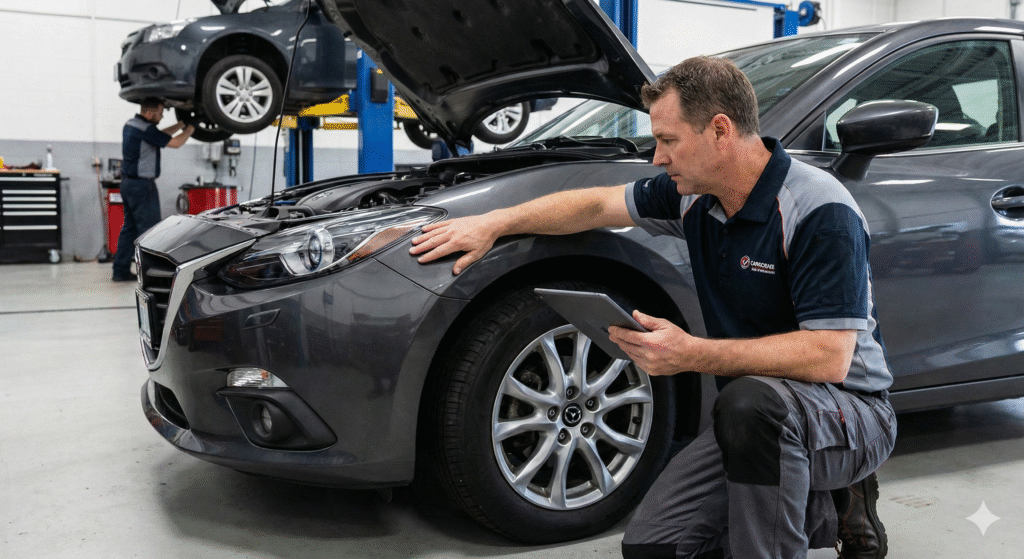
When a dealership takes your car on trade, they cannot simply turn around and sell it immediately. To sell a car to the next customer, the dealer is legally required to perform a Safety Inspection.
This is where the trade-in value is adjusted. The dealer has to deduct the anticipated costs of making the car road-worthy and safe. Common deduction points include:
Tires: If the tread is low, the dealer must buy a new set.
Brakes: Worn pads or rotors must be replaced.
Fluid Leaks: Oil or transmission leaks must be fixed.
Windshields: Cracks or chips often require replacement.
If your car needs $2,000 worth of work to pass a safety inspection, that cost is factored into the trade-in offer.
- The Hidden Bonus: Tax Savings
This is the most overlooked benefit of trading in your vehicle. When you trade in a car you own (whether you have the cash title or are financing it), you receive a tax credit.
You only pay tax on the difference (the balance), not the full price of the new car.
The Math: How You Save
Let’s assume you are buying a vehicle where the tax rate is 12%.
You trade in your car for $20,000.
Because that $20,000 is deducted from the taxable amount of the new car, you save the tax on that amount.
Savings: $20,000 x 12% = $2,400.
To equal this benefit selling privately, you wouldn’t just need to sell your car for $20,000—you would actually need to sell it for $22,400 just to break even with the dealer’s offer. This tax advantage often bridges the gap between a private sale price and a trade-in offer.
- Selling Privately: Higher Price, More Work
Selling your car privately will almost always get you a higher “gross” price than a trade-in, but it comes with caveats.
No Inspection Required: You generally don’t have to provide a safety inspection to sell privately.
More Risk & Effort: You have to list the car, meet with strangers, handle test drives, and navigate payment scams.
Time: It can take weeks or months to find a buyer.
- When Should You Sell Privately?
While trading in offers convenience and tax savings, there is one scenario where selling privately usually makes more sense: Low-Value Vehicles.
If your car is an older model worth only a few thousand dollars (e.g., $3,000 or less), the dealer’s reconditioning costs might exceed the car’s value, resulting in a very low offer. In this specific case, the tax savings (12% of $3,000 is only $360) are not significant enough to outweigh the cash you could get from a private buyer who is looking for a cheap “as-is” runner.
Ready to Upgrade?
Stop guessing and get a real number. At CarApproval.ca, we look at the whole picture to get you the best possible approval and trade-in value.